

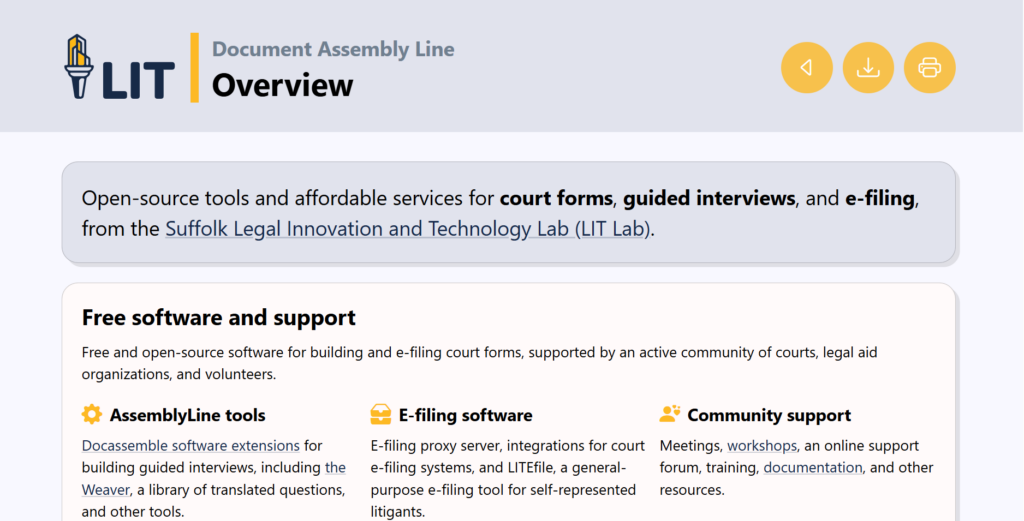
The Document Assembly Line, created by the Legal Innovation and Technology Lab (LIT Lab) at Suffolk University Law School, helps individuals build open-source access-to-justice tools and resources for court forms, online guided interviews, and e-filing. It provides affordable Docassemble hosting and e-filing tools for courts and legal aid organizations. The LIT Lab has also created free and open-source software for building and e-filing court forms, supported by an active community of courts, legal aid organizations, and volunteers such as:
In May 2025, an eviction sealing law went into effect in Massachusetts. Suffolk LIT Clinic students, in collaboration with the Massachusetts Trial Court, built an online guided interview tool. The tool makes it easy to complete a petition to seal an eviction and e-file it with the court. During the first week, more than 300 people completed the petition using the new guided interview. Learn more: https://suffolklitlab.org/eviction-sealing-tool-launched-with-massachusetts-trial-court/
“A well-designed form allows people to express themselves in a way the court can understand.”
—David Colarusso, Suffolk LIT Lab Co-Director
August 1, 2022
King County, Washington, was ground zero for the beginning of the COVID-19 pandemic in the United States. The Washington State Supreme Court suspended most court operations in all courts on March 18, 2020. Acknowledging access to justice is of critical importance, King County Superior Court (KCSC) leadership vowed to continue to hold matters on all …
July 1, 2022
Juvenile court judges are the most important public figures in the juvenile justice system–their decisions impact whether hundreds of thousands of youth each year become court involved and for how long, whether they are involuntarily removed from their homes and communities, and the services they receive. Despite the importance of these judges, states and locales …
June 1, 2022
Each county in Mississippi contains its own Justice Court where community members bring legal actions to settle local, small-dollar disputes. Court regulations and policies vary in each county, and they can be incredibly confusing for Mississippians to navigate, almost all of which are pro se litigants. The COVID-19 pandemic created more variation as judges and …
May 2, 2022
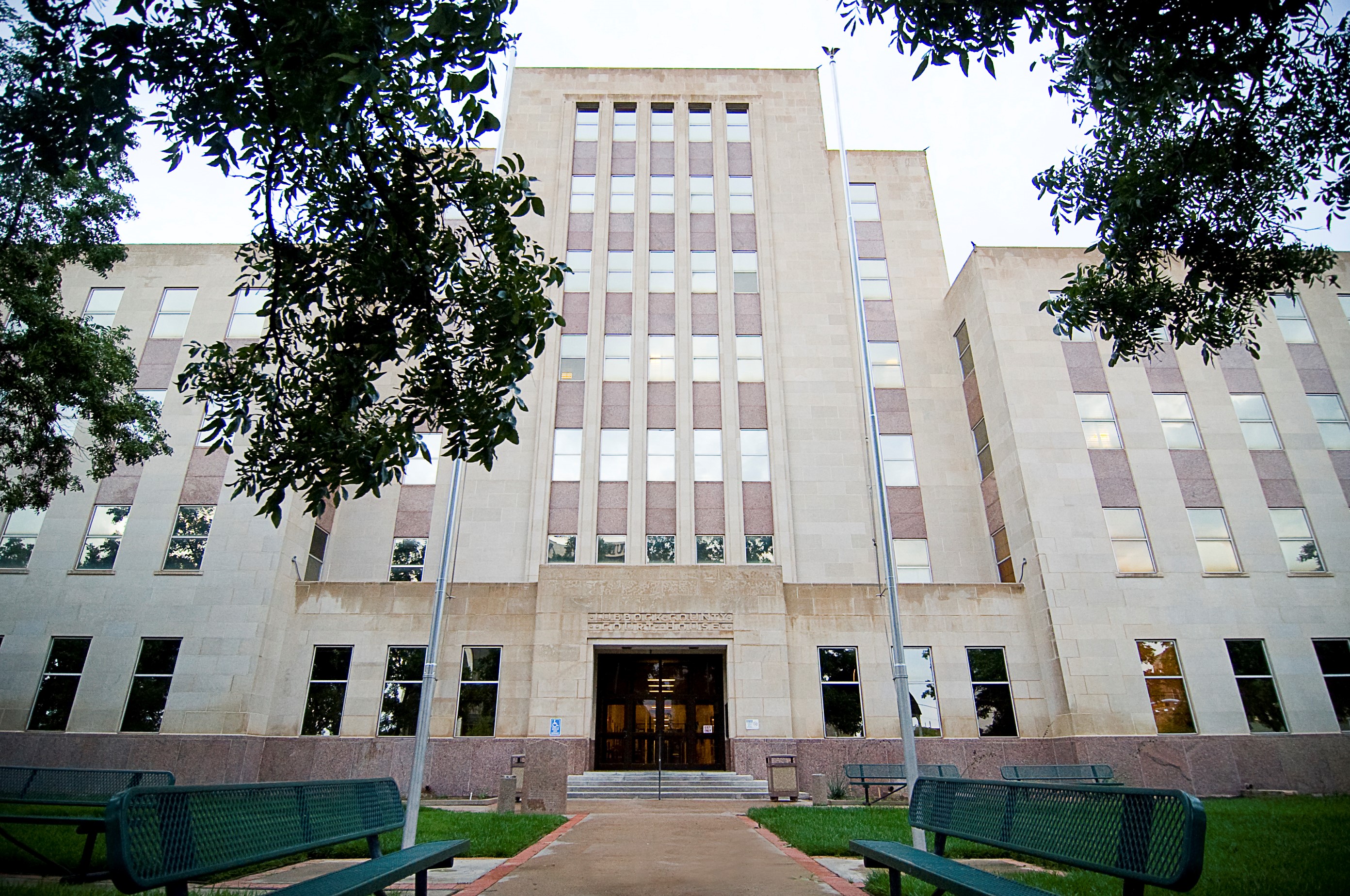
Participating in the judicial system can be traumatic and stressful. Mediation is a tool used for resolving many judicial matters, thus mediators often encounter disputants experiencing the worst time of their lives. With this in mind, Texas Dispute Resolution System™ (TDRS) began a process to enhance their mediators’ skills and knowledge when engaging disputants during …
April 1, 2022
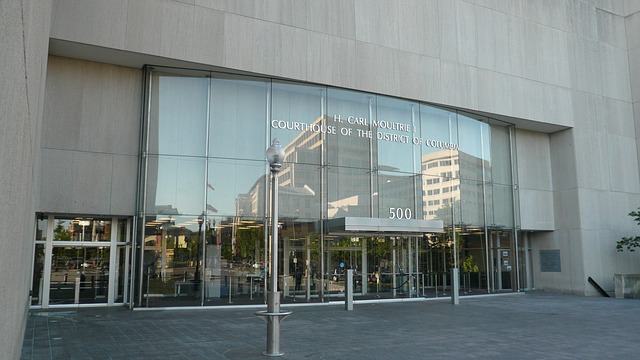
The State Justice Institute awarded a key grant to the District of Columbia Courts’ Office of Court Interpreting Services to launch the Courts’ Interpreter Registry and the first-ever Amharic Court Interpreter Certification Examination. These initiatives demonstrate the Courts’ commitment to increase access for Limited English Proficient (LEP) and deaf or hard-of-hearing individuals to the judicial …

March 1, 2022
In November 2020, the Family Center of the Conciliation Court (FCCC) within the Arizona Superior Court in Pima County, was awarded a Pandemic Response and Recovery grant from the State Justice Institute (SJI) to implement the Court’s vision of converting what was an employee-led, in-person parent education course to an on-demand, online, and self-paced e-Learning …