
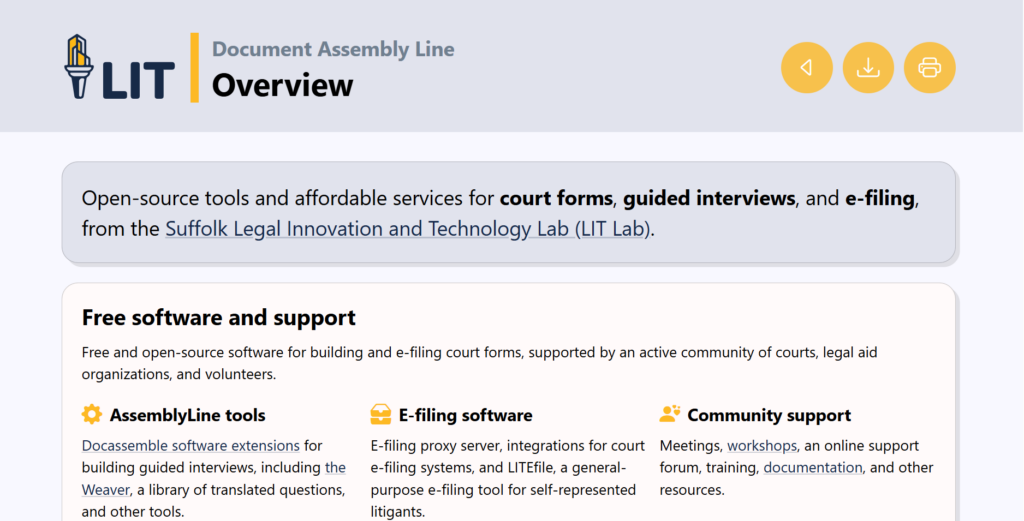
The Document Assembly Line, created by the Legal Innovation and Technology Lab (LIT Lab) at Suffolk University Law School, helps individuals build open-source access-to-justice tools and resources for court forms, online guided interviews, and e-filing. It provides affordable Docassemble hosting and e-filing tools for courts and legal aid organizations. The LIT Lab has also created free and open-source software for building and e-filing court forms, supported by an active community of courts, legal aid organizations, and volunteers such as:
In May 2025, an eviction sealing law went into effect in Massachusetts. Suffolk LIT Clinic students, in collaboration with the Massachusetts Trial Court, built an online guided interview tool. The tool makes it easy to complete a petition to seal an eviction and e-file it with the court. During the first week, more than 300 people completed the petition using the new guided interview. Learn more: https://suffolklitlab.org/eviction-sealing-tool-launched-with-massachusetts-trial-court/
“A well-designed form allows people to express themselves in a way the court can understand.”
—David Colarusso, Suffolk LIT Lab Co-Director
September 1, 2023
Rural communities face unique challenges that impact their ability to deliver fair and equitable justice. Despite these challenges, rural communities rely on their many strengths to address the needs of their residents. In 2021, the National Center for State Courts, in partnership with Rulo Strategies, launched the Rural Justice Collaborative (RJC) to showcase the strengths …
July 1, 2023
The National Judicial Network: A Lifeline Helping Judges Better Serve Human Trafficking Victims and Immigrant Victims of Crime and Abuse The National Judicial Network (NJN): Forum on Human Trafficking and Immigration in State Courts offers judges an opportunity for peer-to-peer learning and information sharing. Judges from all over the country who are interested in the …

June 1, 2023
The Good Judge-ment Podcast is an educational, web-based podcast for judges, lawyers, students and nerds of all kinds. The podcast started in 2016 as a supplement to ongoing educational programming for Georgia Superior Court judges. From that beginning, it has grown to a bi-weekly program with hundreds of subscribers and over 125 episodes. The hosts, …
May 1, 2023
With the certification of 64 resource judges and four court resource attorneys’ mid-summer 2022, the National Courts and Sciences Institute (NCSI) completed Phase 1 of a SJI-supported strategic initiative to discover ways to train judges and court personnel to cope with novel, changing, Covid Science in the Courtroom. Judges from 12 jurisdictions in coordinator-facilitated teams …
April 1, 2023
During the past two years, Neighborhood Preservation, Inc. worked with the City of Memphis and Shelby County to launch the local Emergency Rental Assistance program, a $90 million program with a strong eviction prevention and legal services component. The SJI grant supported the development of court data tools to identify ERA applicants facing upcoming court …
March 1, 2023
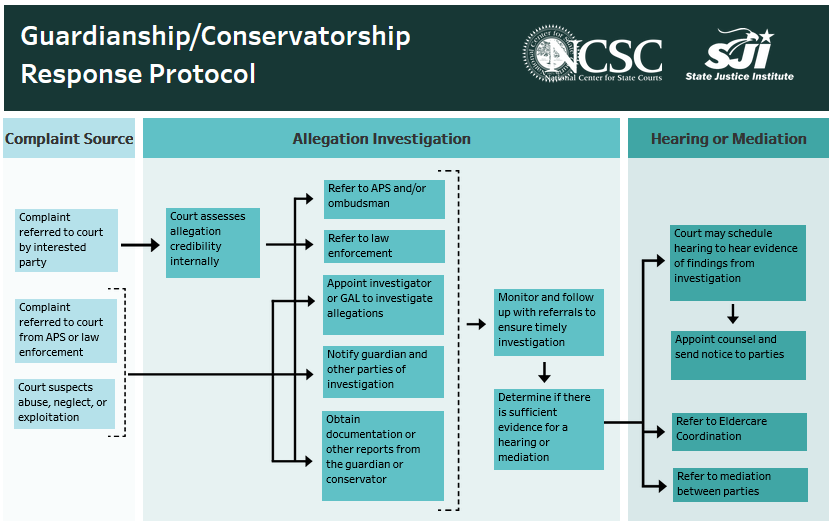
To improve guardianship case management, the National Center for State Courts is leading two SJI-funded projects to help guide courts through guardianship monitoring. Developing a Judicial Response Protocol to Address Abuse, Neglect, and Exploitation in Guardianship Cases features an interactive tool designed to help judges respond to allegations of harm to individuals subject to guardianship. …