
In 2021, with support from State Justice Institute, the National Center for State Courts, in partnership with Rulo Strategies LLC, launched the Rural Justice Collaborative (RJC) to showcase the strengths of rural communities and highlight the cross-sector collaboration that is a hallmark of rural justice systems. These strengths include strong professional networks, deep ties to the communities they serve, resiliency, and ingenuity. The video below highlights the mission of the RJC: https://vimeo.com/735789228
Author: Lauren Curtis
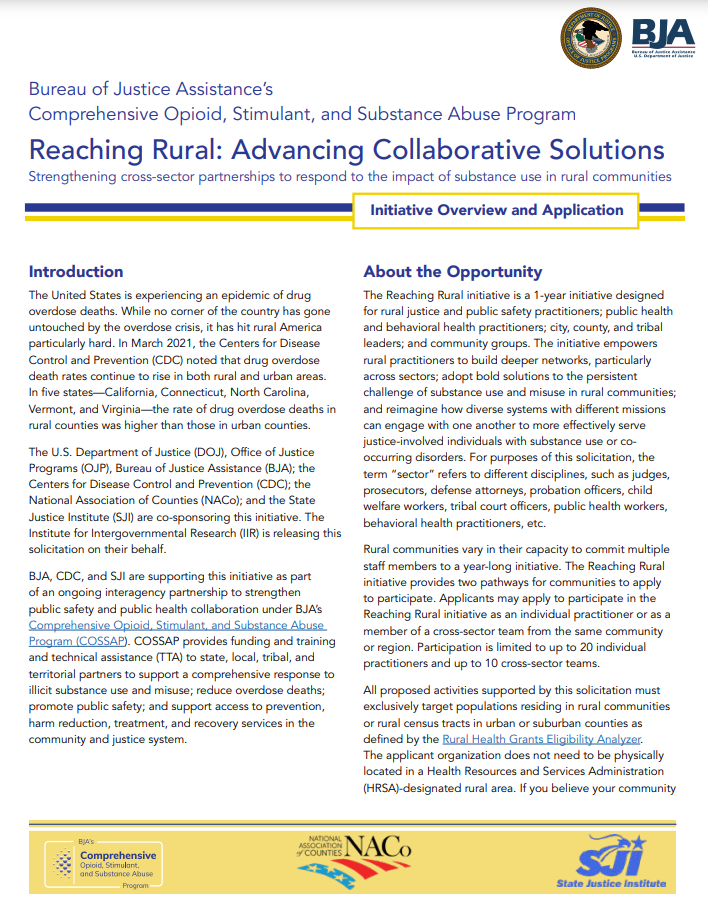
Announcing the Launch of the Reaching Rural Initiative
On behalf of The United States Department of Justice, OJP Bureau of Justice Assistance (BJA); the Centers For Disease Control and Prevention (CDC); the State Justice Institute (SJI); the National Association of Counties and the Institute for Intergovernmental Research, we are excited to share with you a new initiative, Reaching Rural: Advancing Collaborative Solutions. BJA, CDC, and SJI are supporting this initiative as part of an ongoing interagency partnership to strengthen public safety and public health collaboration under BJA’s Comprehensive Opioid, Stimulant, and Substance Abuse Program (COSSAP). COSSAP provides funding and training and technical assistance (TTA) to state, local, tribal, and territorial partners to support a comprehensive response to illicit substance use and misuse; reduce overdose deaths; promote public safety; and support access to prevention, harm reduction, treatment, and recovery services in the community and justice system.
What is the Reaching Rural initiative?
The Reaching Rural initiative is a one-year initiative. Over the course of the year, the selected individuals and teams will receive coaching and participate in skill-building workshops as well as virtual and in-person learning experiences.
Participation in the Reaching Rural initiative includes:
·Travel and per diem costs to participate in an orientation, a field visit to observe the implementation of evidence-informed practices in a rural setting, and a closing session at the end of the 12 months. This is not a grant opportunity.
· Monthly mentorship and guidance aimed toward your local needs.
· Monthly assignments that help you apply core concepts to your local community or region.
· Access to a diverse network of rural peers, innovative rural communities, and technical assistance providers.
· Formal recognition for completing the planning initiative.
Apply now! Seeking Applicants for the Reaching Rural Initiative – Deadline September 30th, 2022. For more information click on the image below or visit: Reaching_Rural_Solicitation-Final.pdf (cossapresources.org)
NCSC Publishes Best Practices for Court Building Security 2022 Edition
Now in its fourth edition, Steps to Best Practices for Court Building Security delivers updated guidance on a diverse array of court security topics. Examples include recommendations for implementing remote hearings for in-custody defendants and recommendations for security technology. The new release highlights how courts can integrate technology into building infrastructure—including security control centers, alarms, access control technology, and cameras. The updated guidance also incorporates greater attention to how architectural design can create safe separation and circulation for all court participants. The 2022 update also reinforces fundamental security concepts for courts of all shapes and sizes.

To help courts achieve these fundamental practices, the National Center for State Courts (NCSC) evaluates the effectiveness of court building security programs through responses to questions, such as:
- Is there a Court Security Committee in place? How does it function?
- Who is “in charge” of security in the courthouse? How do you know who’s in charge?
- What policies and procedures are in place? How are they developed?
- What training and exercise programs are in place? Who participates and how often are they conducted?
- Who gets screened for weapons?
- Who has access after hours?
- What is your role and responsibilities with respect to security?
To learn more about NCSC’s court security services, please visit the Court Security and Emergency Preparedness web page.
King County Superior Court, Washington – The Response of the King County Superior Court to the COVID-19 Pandemic: Lessons Learned and Recommendations
King County, Washington, was ground zero for the beginning of the COVID-19 pandemic in the United States. The Washington State Supreme Court suspended most court operations in all courts on March 18, 2020. Acknowledging access to justice is of critical importance, King County Superior Court (KCSC) leadership vowed to continue to hold matters on all case types, including jury trials, at the earliest time possible.
With adapted operational procedures, new court technology, a public health plan, and legal community support, KCSC held over 300 jury trials, 1,000 bench trials, and countless hearings between July 2020 and December 2021.
Evaluating and institutionalizing best practices initiated during the crisis. In October 2020, KCSC was awarded a SJI Pandemic Response and Recovery Grant to 1) develop a values-based evaluation framework to assess the effectiveness and impact of pandemic implemented new practices; and 2) use the results to inform and/or shape future court policy, increase the efficiency and effectiveness of the court, and ensure new service delivery approaches and innovative practices were refined and normalized post-pandemic.
Under the expert guidance of Dr. Brenda Wagenknecht-Ivey, KCSC’s project spanned 19 months and included workshops, focus groups, and surveys. From a lengthy list of new practices implemented during the pandemic, three were selected for evaluation:
- Virtual court proceedings including virtual interpreting and electronic exhibits
- Virtual jury selection
- Remote work (excluding courtroom personnel)
Check out the findings and recommendations from this study. KCSC’s experiences may help shape the future of virtual processes and practices in your Court.
Improving Systems through Collaboration: Top Down or Bottom Up? Both!
Upcoming Webinar! Thursday, July 14th, 2022, from 1:30-3:00PM EST. Improving Systems through Collaboration: Top Down or Bottom Up? Both!
Catalysts for change exist at all levels of social service, health, and court systems—from state-level leaders to local agency directors. Sustaining practice and policy changes require local implementation efforts that in turn rely on state support.
The National Center on Substance Abuse and Child Welfare’s (NCSACW) upcoming panel discussion highlights the lessons and successes of change implementation.
The panel examines how sustaining system-level change: 1) maximizes implementation efforts, and 2) ensures programs remain effectively and equitably delivered and sustained—from the top down and bottom up. These lessons stem from NCSACW’s specialized technical assistance programs: In-Depth Technical Assistance (IDTA) and Regional Partnership Grant (RPG).
Join this facilitated discussion to ask questions and network with other tribes, states, and communities. Learning objectives include:
Understand how to make change at the local and state levels.
Identify practice-level strategies necessary to create systems-level change.
Build collaborative capacity with partner agencies and systems.
Engage strong leadership to assure collaboratives develop mutually defined goals, make lasting practice changes, and mitigate systemic barriers to improve outcomes for children and families.
Registration is free. Register here: Webinar Registration – Zoom
Kansas Judicial Branch Maximizes SJI Grant Funding
Over the past decade, the Kansas Judicial Branch has used SJI grants to accomplish many of its objectives, including improving its workforce and commencing access to justice initiatives. In FY 2016, an SJI grant (SJI-16-T-149) enabled the Judicial Branch to contract with the National Center for State Courts (NCSC) for an independent assessment of job classifications and rates of compensation for employees and district magistrate judges. The results were astonishing:
- Every employee job classification was 4.6 percent to 22.2 percent below market;
- Nine job classes, covering more than one-quarter of all employees, had a starting salary below the Federal Poverty Guideline for a family of four;
- Two classifications, (Trial Court Clerk II and Court Services Officer I), comprising approximately half of the Judicial Branch’s positions, were 17.8 percent below market.
- Nearly one-third of employees were working more than one job to make ends meet, and many more were looking for additional work outside the Judicial Branch for the same reason.
The NCSC updated the study in 2018, and calculations were revised the following years using the Consumer Price Index to account for market adjustments.
The salary issues were due to chronic underfunding of the Kansas court system. During one stretch, Kansas judges did not receive a pay increase for nine years, and employee position pay was not increased for eight years, except for a one-time 2 percent cost of living increase which was offset by increased employee benefit contributions. The SJI-funded classification and compensation study illustrated how significantly below market employee positions were, and provided a solid, independent basis for the Judicial Branch’s efforts in working with the Legislature to provide adequate funding for salaries. The Legislature recognized the situation and began annually increasing employee salaries to bring them to market rate.
In 2019, the Legislature appropriated a 5 percent increase to the Judicial Branch’s employee pay pool, which enabled the Supreme Court to allocate raises in proportion to the compensation study. The Legislature also appropriated 2.5 percent increases in 2018 and 2020. During the 2021 legislative session, the Legislature appropriated funding over two years to raise Judicial Branch employees to market rate, in accordance with the compensation study. That same year, the Legislature provided judges with 5 percent salary increases for fiscal years 2022 and 2023. During the 2022 session, the Legislature appropriated a 5 percent across-the-board increase for employees and judges for a cost-of-living adjustment. The impact of these increases is staggering. For the first time in decades, employee positions are at or near market pay and judges salaries are moving toward competitiveness.
A weighted caseload study for judges and clerks was initially performed by the NCSC in 2011. Because this caseload study provided valuable data, the Judicial Branch continued working with the NCSC on updates for judges, clerks, and administrative assistants. While this project was not supported with SJI funding, the Judiciary used the results as a basis for requesting and receiving additional positions in FY 2022. This project, in addition to the compensation study, provided adequate compensation figures for the positions contained in the weighted caseload studies.
The Kansas Judicial Branch has relied on SJI grant-funded projects for more than its salary efforts. Other successful projects supported by SJI over the years include:
- A 2019 NCSC performance audit of services to self-represented litigant needs and services (SJI-19-T-031). The audit included several site visits around the state, and detailed surveys of system stakeholders. The results of the audit include a report providing a roadmap for expanding the reach and impact of self-help services in Kansas. The Kansas Office of Judicial Administration, in conjunction with the Kansas Supreme Court’s Access to Justice Committee, has already made considerable strides toward implementing many of the report’s recommendations.
- A 2012 review of court collections processes, which resulted in legislative changes including the transfer of court collections contracts oversight from the Kansas Attorney General’s Office to the Judicial Branch.
New Release: The Steps to Best Practices for Court Building Security
The National Center for State Courts has just announced the publication of the revised 2022 edition of Steps to Best Practices for Court Building Security. The Steps to Best Practices document is intended to provide guidance to courts throughout the country in enhancing the security and safety of their court facilities. The document forth guidelines for what constitutes best practices in various areas of court building security. It also sets forth steps in phases that can be taken toward achieving these best practices. These steps may be helpful for courts as they strive to prioritize and implement improvements in court building security.
The current publication is the 4th edition of the Steps to Best Practices. The previous editions were published in 2010, 2013, and 2016.
For more information please visit: Steps to Best Practices for Court Building Security – Courthouse Facilities – National Center for State Courts (oclc.org)
Council of State Governments Justice Center – Courting Judicial Excellence in Juvenile Justice- A 50 State Study
Juvenile court judges are the most important public figures in the juvenile justice system–their decisions impact whether hundreds of thousands of youth each year become court involved and for how long, whether they are involuntarily removed from their homes and communities, and the services they receive. Despite the importance of these judges, states and locales have generally not assessed whether and how the structure, roles, and operations of their juvenile courts support or hinder public safety and positive youth outcomes.
To support improved practice, the Council of State Governments Justice Center, in partnership with the National Council of Juvenile and Family Court Judges, conducted an analysis of how juvenile courts are structured and operate in all 50 states. The resulting report, Courting Judicial Excellence in Juvenile Justice, highlights key recommendations to improve juvenile court policy and practice and includes examples of best practices across the country. Key recommendations include:
- Establish specialized and dedicated juvenile and family court judges
- Ensure that judges hearing delinquency cases have the tools and resources necessary to adjudicate delinquency cases in a developmentally appropriate way
- Require all judges who hear delinquency cases to receive ongoing training on juvenile justice
- Establish dedicated forums focused on strengthening and supporting juvenile court
- Identify statewide performance measures for juvenile court
An accompanying tool, which highlights key juvenile court metrics, can be found at the Juvenile Justice GPS. Additionally, NCJFCJ passed a resolution on the importance of juvenile court specialization which can be found here.
Task Force Releases Comprehensive Guidelines, Principles for Juvenile Mental Health Diversion
Task Force Releases Comprehensive Guidelines, Principles for Juvenile Mental Health Diversion Upwards of 70% of young people in the justice system have a diagnosed mental disorder, and 90% have experienced a traumatic life event that can negatively impact their mental health. To assist courts and service providers in addressing the growing mental health crisis, the National Judicial Task Force to Examine Courts’ Response to Mental Illness recently released a set of Juvenile Justice Mental Health Diversion Guidelines and Principles.
To view the New Task Force Resources Released, please visit: Task Force Releases Comprehensive Guidelines, Principles for Juvenile Mental Health Diversion | NCSC
New Videos Explain the Basics of Conservatorships
The National Center for State Courts (NCSC) has just released a new set of resources to help courts monitor conservatorship cases. A three-part video series for court staff is now available online and provides guidance on case management, detecting red flags and ways to respond to suspected fraud or abuse.
The videos – Monitoring Conservatorship and Guardianship Cases, Red Flags in Financial Reports and Responses to Potential Fraud or Abuse – provide specific instruction on how court staff can ensure a conservator or guardian appropriately fulfills their duties through communication and effective case management. Court staff can also learn how to identify and report suspected fraud.
To ensure conservatorship cases are effectively managed, NCSC recommends that courts:
- Make expectations clear by providing instructions and communicating deadlines to conservators.
- Adopt case management practices that can easily track pending and closed cases, along with important deadlines and missing reports.
- Proactively develop an action plan to address issues.
NCSC also released a series of videos for conservators and prospective conservators that defines the role and responsibilities of a conservator. The videos outline specific questions a conservator should ask the court when appointed and provide guidance on what to consider when making decisions on behalf of another person and the information needed to successfully complete reports.